Master the AI Search Optimisation Process for SMEs
Discover the ai search optimisation process for SMEs in Dubai. Follow clear, actionable steps to enhance online visibility and dominate AI-driven search outcomes.

US
Feb 14, 2026
10 min read


Many Dubai businesses are finding that traditional search methods no longer keep pace with the rise of AI-powered engines. Adapting your approach is now vital for maintaining online visibility and customer engagement as search technologies grow smarter. This guide unpacks practical steps to help you assess, refine, and measure AI-driven search strategies, ensuring your SME stays ahead in the competitive digital marketplace.
Table of Contents
Quick Summary
Key Insight | Explanation |
|---|---|
1. Assess AI search opportunities | Evaluate AI-powered search technologies and integrate them into your current strategy for improved performance. |
2. Prioritise local and industry SEO | Tailor your SEO strategy to your regional market and industry specifics for better visibility and engagement. |
3. Implement advanced content optimisation | Use AI-driven tools and strategies to elevate content quality, ensuring it meets both user needs and algorithm standards. |
4. Develop generative content strategies | Create structured, clear content that AI systems can easily understand and synthesise for better visibility. |
5. Monitor AI search performance impact | Implement tracking systems to continually assess the effectiveness of AI search strategies and adapt accordingly. |
Step 1: Assess AI-driven search opportunities
In this crucial step, you'll learn how to systematically evaluate potential AI-powered search opportunities for your digital strategy. Understanding these emerging search technologies can transform your approach to online visibility and information discovery.
The landscape of search is rapidly evolving, particularly with AI systems transforming scientific discovery. To assess AI-driven search opportunities effectively, start by mapping out your current search strategy and identifying potential integration points. This involves several key activities:
Analyse your existing search performance metrics
Identify knowledge gaps in your current approach
Research emerging AI search technologies
Understand your target audience's search behaviours
Evaluate potential AI tools for search enhancement
Strategic AI search assessment requires a comprehensive view of technological capabilities and user expectations.
Specifically, look at how AI-powered search engines leverage language models to provide summarised information. This means examining tools that can automate literature reviews, generate research hypotheses, and provide nuanced search results beyond traditional keyword matching.
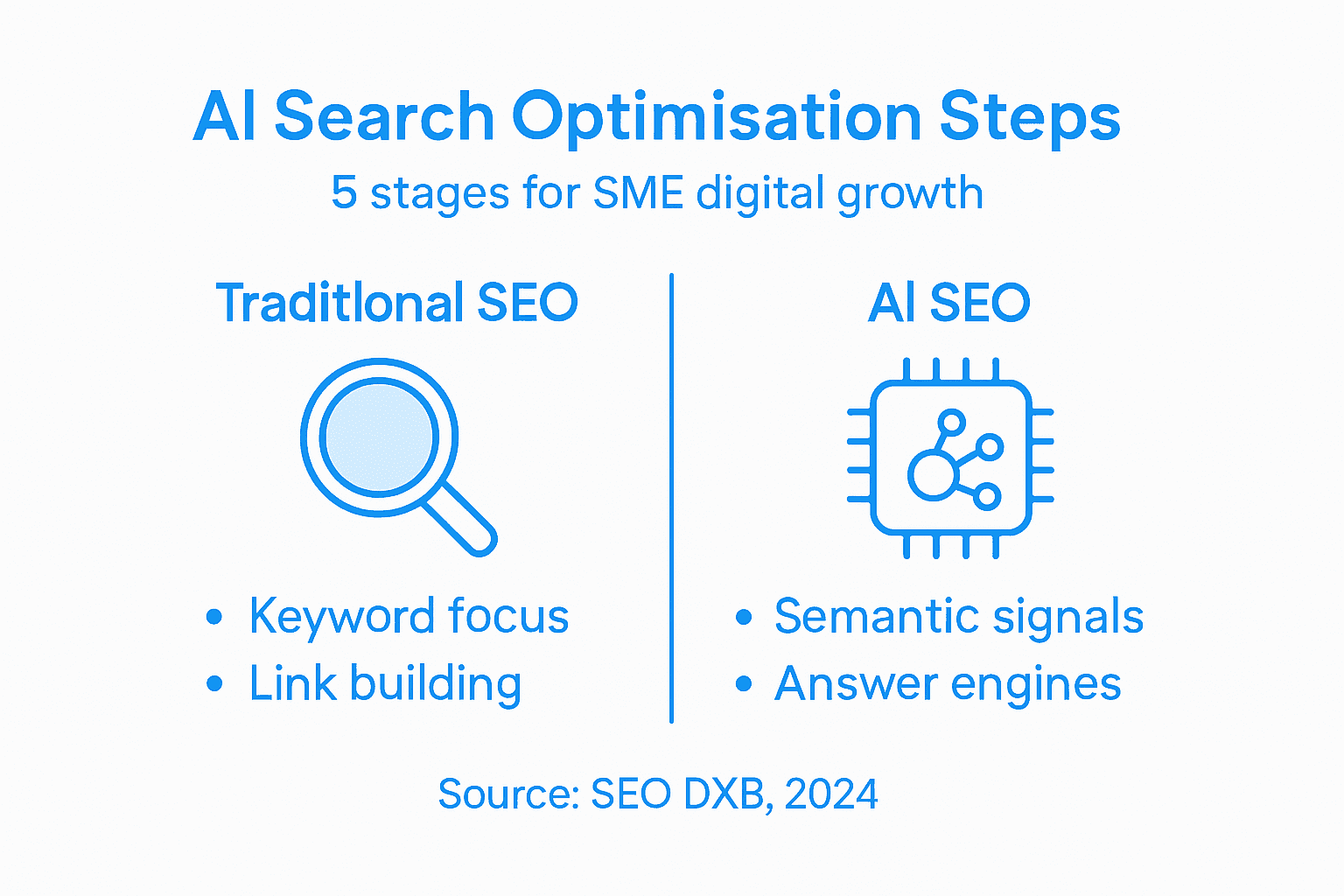
Consider conducting small-scale experiments to test these new search methodologies, comparing their performance against your existing strategies. Focus on metrics like information retrieval speed, relevance of results, and potential efficiency gains.
Here is a summary comparing traditional and AI-driven search optimisation strategies:
Aspect | Traditional Search Optimisation | AI-driven Search Optimisation |
|---|---|---|
Approach | Focus on keywords and meta tags | Semantic analysis and language models |
Adaptability | Slow to apply new trends | Rapid adaptation via AI learning |
User Intent Understanding | Limited to keyword matching | Deep understanding of user queries |
Content Relevance | Based on manual curation | Automated, data-driven enhancement |
Performance Measurement | Standard SEO metrics | Advanced, multidimensional analytics |
Top tip: Begin with a pilot project targeting a specific research or content area to minimise risk and maximise learning about AI search capabilities.
Step 2: Define local and industry SEO priorities
In this critical step, you'll develop a nuanced strategy for identifying the most impactful SEO priorities tailored specifically to your local market and industry sector. Understanding the unique search dynamics of your business context is fundamental to effective digital visibility.
Regional SEO ranking factors vary dramaticallyacross different geographical areas and industry segments. To define your priorities effectively, you'll need a strategic approach that considers multiple dimensions:
Analyse your specific regional search characteristics
Identify industry-specific SEO ranking signals
Map local competitive search landscape
Determine most relevant performance metrics
Prioritise adaptable search optimisation strategies
Local SEO success requires granular understanding of regional and sectoral search behaviours.
Each industry has unique search priorities. For instance, healthcare organisations might prioritise website authority and credibility, while retail businesses could focus on hyper-local geographical signals. This means your SEO strategy must be carefully calibrated to your specific business context.
Start by conducting a comprehensive audit of your current online presence, examining how your digital footprint aligns with local search expectations. Consider factors like Google My Business optimisation, localised content strategy, and region-specific keyword targeting.
Expert advice: Develop a flexible SEO framework that can quickly adapt to emerging local search trends and technological shifts in your specific industry and region.
Step 3: Implement advanced content optimisation
In this crucial step, you'll transform your content strategy by integrating sophisticated optimisation techniques that elevate your digital presence and search engine performance. The goal is to create intelligent, precision-targeted content that resonates with both search algorithms and human readers.
Advanced content review methods leverage cutting-edge technologies to enhance content quality and reliability. To implement advanced content optimisation, consider these strategic approaches:
Integrate AI-powered content analysis tools
Develop comprehensive content quality metrics
Implement semantic keyword optimization
Create contextually rich, authoritative content
Continuously refine content based on performance data
Effective content optimisation requires a dynamic, technology-enabled approach that balances algorithmic insights with human creativity.
Your optimisation strategy should focus on deep semantic understanding rather than simplistic keyword stuffing. This means creating content that demonstrates genuine expertise, answers user queries comprehensively, and provides unique insights specific to your industry.
Evaluate your existing content through multiple lenses. Technical content analysis involves examining readability, keyword density, topical relevance, and potential areas for improvement. Use AI-driven tools to identify gaps in your current content strategy, ensuring each piece meets high standards of originality and informational value.
Expert recommendation: Develop a systematic content review process that combines technological analysis with human expertise to consistently elevate your digital content quality.
Step 4: Apply generative and answer engine strategies
In this pivotal step, you'll learn to optimise your content for emerging AI-driven search platforms, transforming how your digital presence interacts with intelligent search technologies. The goal is to develop a strategic approach that maximises your visibility across generative search environments.
Generative Engine Optimization (GEO) addresses content visibility challengesby creating structured content designed for AI search synthesis. To implement these advanced strategies effectively, focus on these key approaches:
Design content for AI comprehension
Enhance semantic structure and clarity
Develop modular, citation-friendly content
Create authoritative, context-rich information
Optimise for multiple search interpretation paths
Successful generative search strategies require a nuanced understanding of AI content retrieval mechanisms.
Your strategy should prioritise structured content design that enables AI systems to easily extract and synthesise information. This means creating content with clear hierarchies, precise definitions, and comprehensive explanations that demonstrate deep subject expertise.
Focus on technical content architecture that supports AI interpretation. This involves using clear headings, concise paragraphs, and well-defined sections that allow generative search engines to efficiently parse and represent your content across different search platforms.
Expert recommendation: Continuously experiment with content structures and monitor how AI search engines interpret and present your information to refine your generative search optimization approach.
Step 5: Verify AI search performance impact
In this critical step, you'll develop a comprehensive approach to measuring and evaluating the tangible outcomes of your AI search optimisation strategies. The goal is to transform data insights into actionable intelligence that drives continuous improvement.
Generative AI tools impact performance variably, demanding a nuanced and systematic verification process. To effectively assess your AI search performance, implement these strategic evaluation methods:
Track key performance indicators (KPIs)
Measure search visibility and ranking changes
Analyse user engagement metrics
Compare traditional versus AI-driven search results
Assess content retrieval and citation rates
Meaningful AI search performance verification requires a holistic, data-driven approach that balances quantitative metrics with qualitative insights.
Your verification strategy should prioritise comprehensive performance benchmarking that goes beyond surface-level metrics. This involves examining how AI search technologies interpret, retrieve, and present your content across different platforms and contexts.
Focus on detailed analytical frameworks that capture the multidimensional impact of AI search optimisation. This means developing robust measurement techniques that track not just rankings, but also the semantic relevance, contextual accuracy, and overall discoverability of your digital content.
Below is an overview of how AI search impacts key business outcomes:
Outcome | Impact of AI Search | Practical Example |
|---|---|---|
Research Efficiency | Accelerates data discovery | Fast literature review using AI |
Content Visibility | Boosts ranking relevance | Higher SERP positions for rich content |
User Engagement | Improves by tailoring responses | Personalised answers increase time spent |
Competitive Advantage | Enables faster market adaptation | Swiftly capitalising on new trends |
Decision Quality | Supplies nuanced, summarised data | Informed strategy via AI insights |
Expert recommendation: Establish a continuous monitoring system that adapts your AI search strategies based on real-time performance data, ensuring ongoing optimization and alignment with evolving search technologies.
Elevate Your SME’s Search Strategy with Expert AI-Driven SEO Solutions
Navigating the complex world of AI-powered search optimisation can feel overwhelming for SMEs striving to improve their local and industry-specific online presence. Common challenges like adapting to generative engine optimisation, enhancing semantic search relevance, and verifying search performance impact require specialised knowledge and precise execution. The article emphasises critical concepts such as generative search environments, semantic keyword optimisation, and AI search performance benchmarking that are essential to mastering AI search optimisation.
At SEO DXB, we understand these pain points and goals deeply. Our advanced solutions are tailored to help SMEs in Dubai harness the power of AI and generative search technologies to gain competitive advantage, boost content visibility, and improve user engagement. From detailed niche discovery to ongoing performance tracking, our services align perfectly with the strategic steps outlined in the article. Discover how our expertise in Answer Engine Optimization and Generative Engine Optimization can future-proof your digital presence and help you dominate both traditional and AI-driven search platforms.
Transform your digital strategy today by partnering with SEO DXB. Visit SEO DXB now to explore how our cutting-edge AI search optimisation services can empower your SME to thrive in Dubai’s competitive market. Take the first step towards mastering AI search with a trusted local specialist who knows how to convert emerging search trends into measurable business success.
Frequently Asked Questions
How can I assess AI-driven search opportunities for my SME?
To assess AI-driven search opportunities, start by analysing your current search performance metrics to identify gaps. Map out your existing strategy, look into emerging AI technologies, and understand your target audience's search behaviours to effectively implement AI enhancements.
What are the key local and industry SEO priorities for SMEs?
The key local and industry SEO priorities depend on understanding specific regional search behaviours and industry ranking signals. Conduct an audit of your online presence and focus on relevant performance metrics tailored to your local market and industry needs to ensure visibility.
How do I implement advanced content optimisation for my SME?
To implement advanced content optimisation, integrate AI-powered content analysis tools for a more comprehensive review of your content quality. Focus on creating contextually rich and authoritative content while continuously refining your strategy based on performance data to enhance your digital presence.
What is Generative Engine Optimisation and how can it help my SME?
Generative Engine Optimisation (GEO) involves designing structured content that aligns with how AI systems retrieve and synthesise information. Create modular, citation-friendly content that is clear and authoritative to enhance your visibility in AI-driven search environments.
How can I verify the impact of AI search performance on my business outcomes?
To verify the impact of AI search performance, establish key performance indicators (KPIs) and track changes in search visibility and user engagement metrics. Analyse qualitative insights alongside quantitative data to measure improvements in content retrieval and overall discoverability.
Recommended
Frequently Asked Questions
How can I assess AI-driven search opportunities for my SME?
To assess AI-driven search opportunities, start by analysing your current search performance metrics to identify gaps. Map out your existing strategy, look into emerging AI technologies, and understand your target audience's search behaviours to effectively implement AI enhancements.
What are the key local and industry SEO priorities for SMEs?
The key local and industry SEO priorities depend on understanding specific regional search behaviours and industry ranking signals. Conduct an audit of your online presence and focus on relevant performance metrics tailored to your local market and industry needs to ensure visibility.
How do I implement advanced content optimisation for my SME?
To implement advanced content optimisation, integrate AI-powered content analysis tools for a more comprehensive review of your content quality. Focus on creating contextually rich and authoritative content while continuously refining your strategy based on performance data to enhance your digital presence.
What is Generative Engine Optimisation and how can it help my SME?
Generative Engine Optimisation (GEO) involves designing structured content that aligns with how AI systems retrieve and synthesise information. Create modular, citation-friendly content that is clear and authoritative to enhance your visibility in AI-driven search environments.
How can I verify the impact of AI search performance on my business outcomes?
To verify the impact of AI search performance, establish key performance indicators (KPIs) and track changes in search visibility and user engagement metrics. Analyse qualitative insights alongside quantitative data to measure improvements in content retrieval and overall discoverability.
Recommended
Share Post: